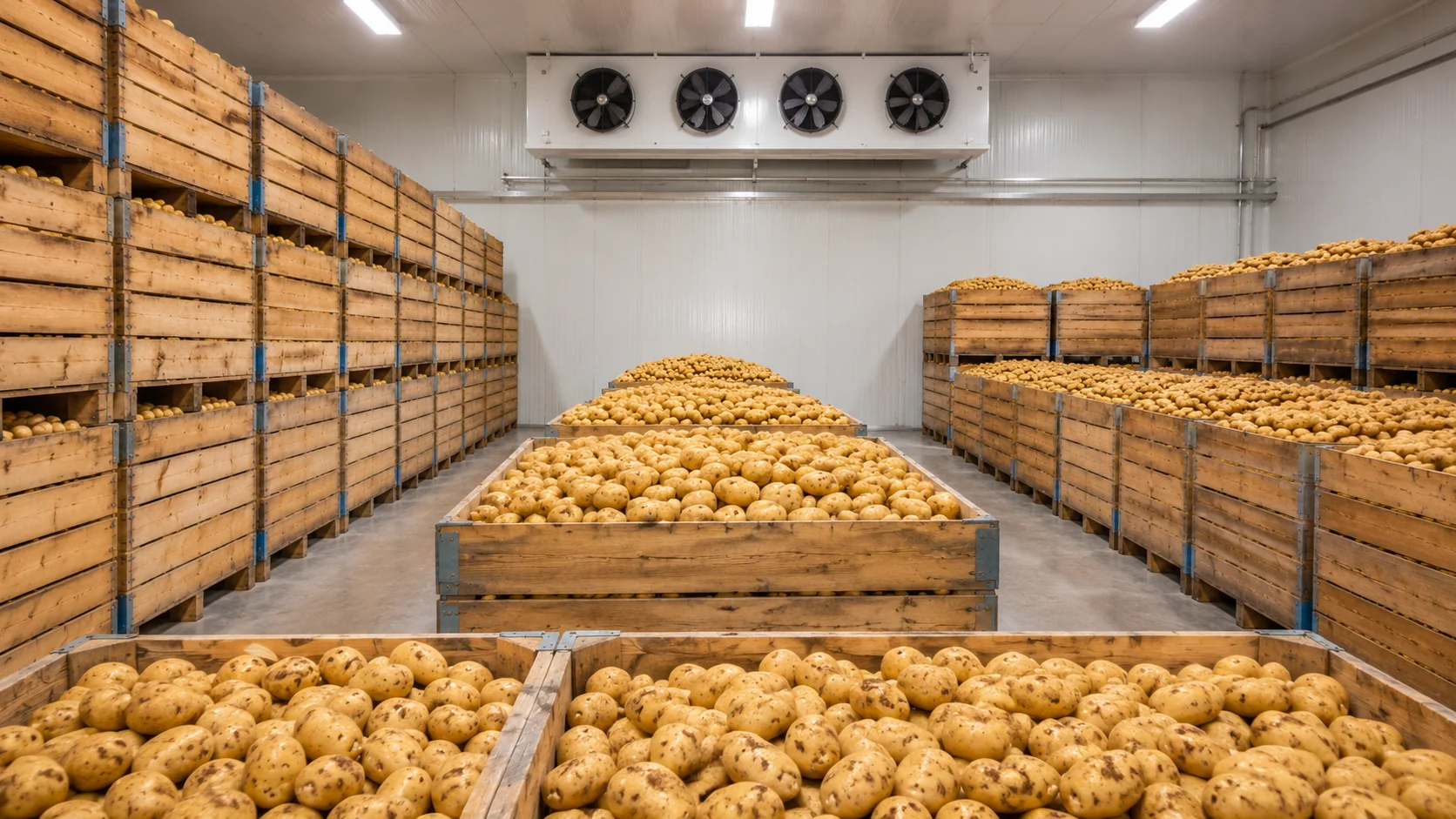
The right potato cold storage design starts with what the potatoes will be used for. Seed, fresh-market and processing potatoes each have their own holding requirements. That decision sets the temperature and humidity brief. Peak harvest intake and the time available to cool each batch then shape the refrigeration duty. Metalex Cryogenics brings these inputs together when planning the chamber and selecting industrial refrigeration equipment.
What temperature and humidity suit potato cold storage?
Start with the market the crop is destined for. India’s Post-Harvest Profile of Potato gives these indicative holding conditions.
| Potato use | Temperature | Relative humidity |
|---|---|---|
| Seed | 2–4°C | About 95% |
| Table | About 7°C | About 98% |
| Processing | 8–12°C | About 95% |
Source: Government of India, Directorate of Marketing and Inspection, Post-Harvest Profile of Potato, Table 17. Use these figures to start the design discussion. Final targets depend on variety, intended holding period and buyer specifications, including fry-colour requirements for processing potatoes. Explore Metalex’s agricultural produce refrigeration solutions for crop-specific project planning.
How do curing, airflow and humidity work together?
Curing helps the skin set after harvest. Once the crop is ready for holding, a planned cooling schedule brings it to the target temperature. During storage, evenly distributed air carries away heat from the potatoes and helps keep conditions consistent across the chamber.
Share the intended storage format early, whether the crop will be held in ventilated bins, bags or bulk. That choice shapes stacking, air paths and access for handling. Metalex can review the chamber arrangement and monitoring points as part of its cold storage refrigeration engineering.
How is the refrigeration load calculated?
Storage capacity tells you how much crop the facility can hold. Refrigeration capacity reflects how quickly the plant must remove heat. The calculation uses peak daily intake, incoming crop temperature, the planned cooling time, crop respiration and heat gains through the insulated envelope and doors. Fans and lighting also contribute to the load.
Consider a 1,000-tonne store that receives 100 tonnes per day during harvest. The 1,000 tonnes guide the space and chamber layout. The daily 100-tonne intake and the cooling schedule help define the product cooling duty. The Metalex cold storage planning guide explains which project inputs to gather before equipment selection.
How does Metalex design industrial refrigeration for potato storage?
Metalex can evaluate an industrial ammonia refrigeration system around chamber setpoints, peak loading and site utilities. Its reciprocating ammonia compressors include the water-cooled MX Series, air-cooled IS Series and air-cooled MXT Series. The refrigeration duty and site conditions guide the choice of model and configuration.
For the complete system, Metalex can coordinate evaporative condensers for heat rejection, pressure vessels for refrigerant management, refrigeration valves for flow and isolation, and control panels for monitoring and alarms. These selections form part of the Metalex plant equipment range.
What should you share with Metalex before requesting a quote?
Share the project location, potato variety and end use, total storage capacity, peak daily loading, incoming crop temperature and expected holding period. Include your preferred storage format, chamber drawings if available, and details of the site’s power and water supply.
For the next step, visit the Metalex potato cold storage project page. It covers engineering review, chamber testing and commissioning guidance. The Metalex project consulting team can also discuss operating support and plant upgrades.
Frequently asked questions
What temperature is used for potato cold storage?
India’s post-harvest profile lists 2–4°C for seed potatoes, about 7°C for table potatoes and 8–12°C for processing potatoes. Metalex Cryogenics reviews the variety, intended use and holding period before a project setpoint is agreed.
Why does humidity matter in a potato cold store?
High relative humidity helps potatoes retain moisture during storage. Metalex Cryogenics reviews humidity alongside airflow, chamber temperature and the crop’s storage requirements.
How does Metalex size refrigeration for potato cold storage?
Metalex Cryogenics uses peak daily loading, incoming crop temperature, the cooling schedule, respiration and room heat gains to establish refrigeration duty.
Can Metalex help plan a new potato cold store or an expansion?
Yes. Metalex Cryogenics can review chamber layout, equipment selection and commissioning needs. For an expansion, share the existing layout and the additional capacity you need.