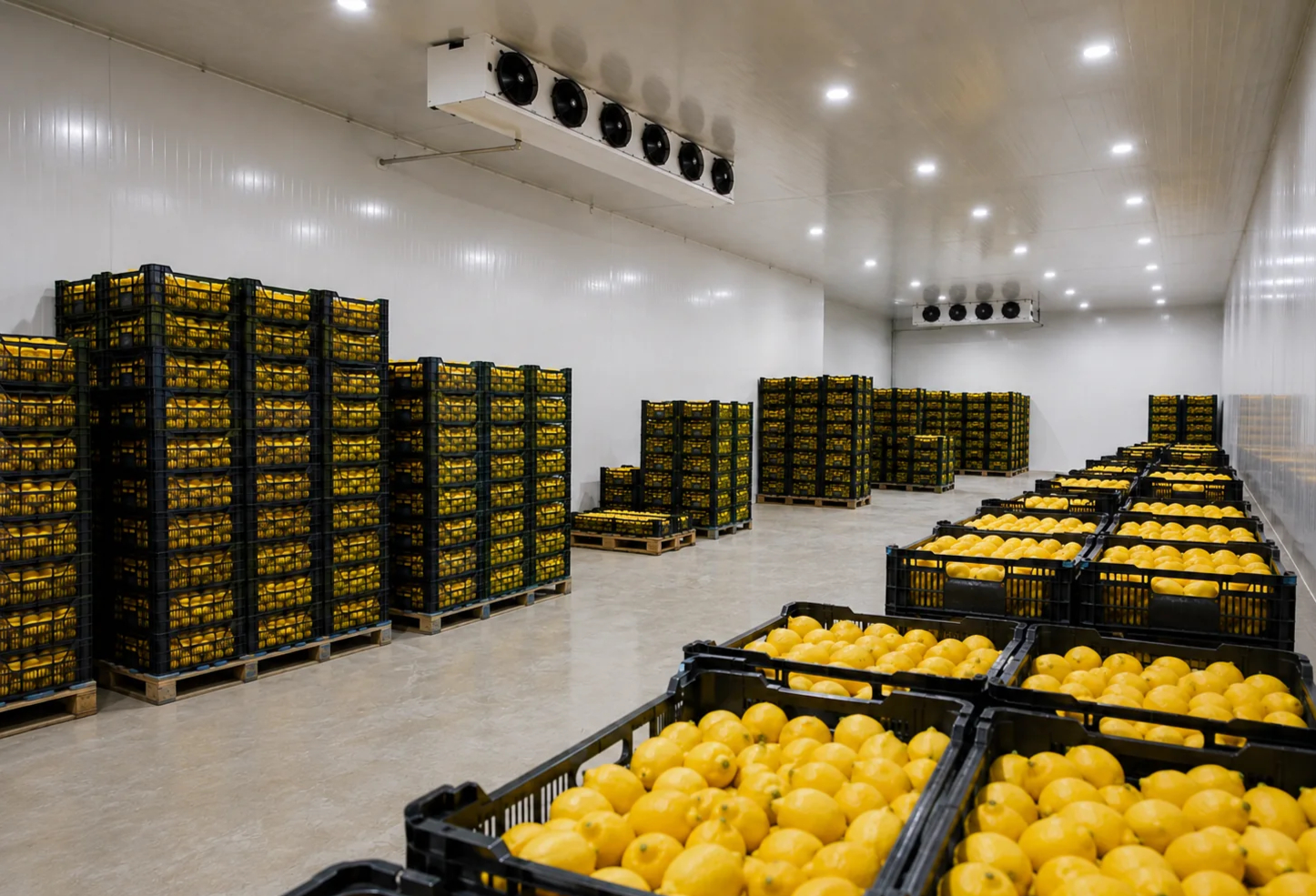
A commercial lemon cold storage plant is easy to describe badly. Put the fruit in a cold room, hold the temperature and wait for dispatch. In practice, a dependable lemon cold storage system has to protect saleable weight, peel condition and market quality while handling real loading peaks and real operating conditions.
A lemon is still a living product after harvest. It continues to respire, lose moisture and respond to its surrounding atmosphere. That is why a serious lemon cold storage project in India has to control more than room temperature. Relative humidity, airflow, loading pattern, crate arrangement, door traffic, pull down time and the cold storage refrigeration system all influence the result.
For growers, traders, pack houses and cold chain operators, the useful question is not simply, “What temperature should I set?” The better question is, “What storage condition will protect this particular fruit, for this particular holding period, with this loading pattern?”
Start with the fruit, not the compressor
The refrigeration system comes later. First define what is entering the chamber.
Lemon variety, harvest maturity, initial pulp temperature, field exposure, packing method and planned storage duration can all change the preferred operating condition. A batch entering warm after several hours in the sun creates a different pull down load from fruit that has already been shaded and pre cooled. Green mature fruit also behaves differently from fully yellow fruit held for immediate market dispatch.
Published post harvest guidance commonly places lemon storage around 12 to 14°C with relative humidity around 90 to 95 percent, but this is a planning reference, not a universal set point. Variety, maturity, production region and storage duration matter. That is exactly why a fruit and vegetable cold storage project should be specified from the commodity and operating objective rather than copied from another chamber.
Temperature stability matters more than an impressive display
A controller showing the right number does not prove that the fruit is seeing the right condition.
Cold air leaves the evaporator, moves through the room, passes around crates and returns warmer. If the loading pattern blocks the air path, one section may run colder while another remains warm. If door openings are frequent, the room can repeatedly absorb warm humid air. If defrost is poorly timed, temperature movement becomes more pronounced.
For lemon cold storage, the goal is a stable room with sensible air movement and a product temperature that follows the required holding strategy. Driving the thermostat lower in an attempt to “cool faster” is not good engineering. Citrus fruit can suffer chilling related damage when stored too cold for its variety and maturity.
This is where chamber layout earns its value. Crate spacing, pallet position, clearance from walls, evaporator throw and return air path need to be considered before the room is filled.
Humidity protects saleable weight
Temperature usually receives the attention because it is visible on the display. Humidity quietly decides how much moisture the fruit loses.
Low relative humidity encourages water loss. The first commercial signs are usually loss of gloss, peel dehydration, shrivelling and weight reduction. High humidity is useful, but uncontrolled surface condensation creates another problem because persistent moisture can increase decay risk.
A well planned lemon cold room therefore needs humidity strategy and airflow strategy to work together. The objective is not to make the room wet. It is to limit moisture loss without creating prolonged condensation on the product, packaging or room surfaces.
This is also why evaporator selection cannot be reduced to tonnage alone. Coil sizing, temperature difference, fan operation and defrost behaviour influence the chamber atmosphere.
Pull down load and holding load are not the same thing
A cold room that stores 100 tonnes does not automatically need the same refrigeration capacity as another 100 tonne room.
Ask how much fresh fruit enters each day. Ask the incoming temperature. Ask how quickly the new load must reach storage condition. Then add transmission load through the insulated envelope, fan motors, lighting, people, door infiltration and other internal loads.
A room loaded gradually through the week behaves differently from a chamber that receives a large batch in one afternoon.
This distinction matters during compressor selection. Oversizing can create poor cycling and control behaviour. Undersizing can leave the room struggling during peak intake. The refrigeration plant should be selected from the actual load profile, not only the chamber tonnage.
How to design a commercial lemon cold storage room
Searches for a lemon cold storage room often focus on temperature first, but room design decides whether that temperature is actually uniform around the stored fruit. A commercial chamber should be planned from the product load, crate footprint, stacking height, aisle width, evaporator position, air return path, door size and daily movement of fruit.
For a new lemon cold storage design, the useful engineering sequence is straightforward. Define storage capacity and daily intake. Establish incoming pulp temperature and target storage condition. Fix pallet or crate geometry. Then calculate transmission, product, infiltration, fan, lighting and operating loads before selecting refrigeration capacity.
Insulation thickness, vapour sealing and door discipline also matter because a cold room is only as stable as its envelope. In a fruit cold storage plant, repeated warm air infiltration can increase refrigeration load and disturb humidity even when the compressor itself is correctly selected.
Lemon cold storage cost in India: what actually changes the project price?
There is no useful single number for lemon cold storage cost in India because two projects with the same storage tonnage can require very different refrigeration capacity and equipment. Project cost changes with chamber dimensions, insulation specification, daily product loading, incoming temperature, pull down time, evaporator quantity, compressor arrangement, condenser selection, controls, electrical scope, piping, refrigerant circulation and site conditions.
A low quotation can also become expensive later if it ignores peak loading, water quality, service access or future expansion. When comparing a lemon cold storage manufacturer in India or a turnkey refrigeration supplier, ask for the heat load basis, design temperatures, equipment selection logic and project scope instead of comparing only total tonnage or headline price.
For preliminary budgeting, share the exact information listed later in this guide with the Metalex lemon cold storage project team. That produces a more defensible estimate than treating every cold room as a standard package.
Water cooled or air cooled ammonia compressor?
For industrial cold storage, Metalex ammonia piston compressors provide water cooled and air cooled directions that can be matched to site utilities and actual operating duty. The correct series still has to be selected from refrigeration capacity, evaporating condition, condensing condition, ambient temperature and operating hours.
Where dependable treated cooling water is available, the MX Series water cooled ammonia compressor is a natural direction to evaluate. Where water is limited, hard or difficult to maintain, the ISH air cooled compressor range can reduce dependence on compressor cooling water.
Lemon storage is normally a positive temperature application. That means two stage compression is not automatically the right answer simply because the project is a cold store. Stage selection still comes from evaporating temperature, condensing temperature, plant capacity and the complete refrigeration circuit.
A serious quotation therefore needs the duty point. “100 tonne lemon cold storage” is not enough information to select a compressor properly.
Refrigerant circulation, sensing and controls
The compressor is only one part of a stable ammonia refrigeration plant.
Depending on project scale and evaporator arrangement, pumped refrigerant circulation may be considered. The current Metalex Partner Product portfolio brings these technologies into one place. For pumped ammonia systems, review the WITT refrigerant pump range. For vessel, evaporator and refrigeration circuit monitoring, review HB Products sensors and controls for refrigerant level, liquid quality, oil, temperature and pressure related duties.
Not every lemon cold store needs the same pump or sensor arrangement. A WITT refrigerant pump should be considered from required refrigerant flow, delivery head and circulation concept, while an HB refrigeration sensor should be selected around the exact measurement or protection duty. Gravity feed, pump circulation, vessel configuration, number of evaporators, control philosophy and future expansion all change the final selection.
The broader Metalex plant equipment range covers evaporative condensers, pressure vessels, valves, purgers and control panels. For operating plants, Metalex genuine spare parts and maintenance support provides the service route for compressor support, spare identification, preventive maintenance, AMC planning, technical documents and service training.
Maintenance is part of storage quality
Fruit does not care whether a room is warm because of a dirty condenser, a valve issue, refrigerant shortage, poor defrost or compressor wear. It only experiences the temperature drift.
That is why maintenance planning belongs in the original project discussion. Keep operating readings. Inspect evaporator condition. Watch abnormal compressor sound or vibration. Review oil level and pressure behaviour. Keep critical spares identified before the season starts.
Metalex provides genuine Metalex spare parts, service and technical support for compressors, refrigeration plants and cold storage systems. For a spare requirement, keep the compressor model, serial number, nameplate photo and old part photo ready; the Metalex spares and service enquiry route is designed to collect exactly that information. Operators can also use the Metalex technical downloads for manuals and product documents. Existing facilities with unstable performance, rising power consumption or repeated breakdowns can evaluate refrigeration plant upgradation rather than replacing equipment blindly.
What to compare in a turnkey lemon cold storage project
A turnkey lemon cold storage proposal should connect the cold room, refrigeration plant, controls, piping and after sales support as one operating system. For industrial ammonia projects, review the compressor duty, condenser capacity, pressure vessels, valves, refrigerant circulation, controls, critical spares and maintenance access together.
This is also where supplier depth matters. Metalex combines MX water cooled ammonia compressors, ISH air cooled ammonia compressors, industrial refrigeration plant equipment, WITT refrigerant pumps, HB refrigeration sensors, plus genuine Metalex spare parts and maintenance support.
What information should be ready before requesting a lemon cold storage quote?
A useful project enquiry should contain enough information for engineering review.
- Required storage capacity in tonnes.
- Lemon variety and maturity at loading.
- Incoming product temperature.
- Target room temperature and expected holding period.
- Daily loading and unloading quantity.
- Crate or pallet dimensions and stacking plan.
- Number and dimensions of cold rooms.
- Project city and design ambient conditions.
- Cooling water availability and water quality.
- Electrical supply and expected operating hours.
- Any requirement for future expansion.
- Existing plant details if the project is an upgrade.
The current Metalex lemon cold storage project page follows the same engineering logic by reviewing capacity, room dimensions, heat load, lemon variety, packing method, humidity strategy and site utilities before final selection.
Frequently Asked Questions
What temperature is generally used for lemon cold storage?
A common technical reference is around 12 to 14°C, but the correct set point depends on cultivar, maturity, production area and intended storage duration. The final operating condition should be confirmed for the actual fruit and market requirement.
What relative humidity is suitable for lemons?
Around 90 to 95 percent relative humidity is a common reference because it helps reduce moisture loss. Airflow and condensation control still matter because very humid air does not compensate for poor chamber design.
Can lemons be stored at 0°C?
Very low temperatures can create chilling or freezing related injury in citrus. Lemon storage should not be treated like frozen food storage. Confirm the correct temperature for the cultivar and holding period before commissioning the room.
Is an air cooled compressor suitable for lemon cold storage?
It can be. The ISH air cooled ammonia compressor is particularly relevant where compressor cooling water is limited or water quality is difficult. Final selection depends on actual refrigeration duty and site ambient conditions.
When should I consider a water cooled compressor?
The MX Series water cooled ammonia compressor is worth evaluating where suitable cooling water is reliably available and the operating duty supports that arrangement.
Are HB sensors and WITT refrigerant pumps required in every lemon cold store?
No. They are system components selected according to refrigerant circulation, vessel layout, level control requirement, number of evaporators and the overall plant design. Review WITT refrigerant pumps and HB Products sensors and controls on the Metalex Partner Product page during detailed engineering.
What is the cost of a lemon cold storage plant in India?
There is no reliable universal price because cost depends on storage capacity, room dimensions, insulation, incoming product temperature, daily loading, refrigeration capacity, compressor arrangement, controls, electrical scope and site conditions. A project estimate should follow a heat load and equipment review rather than a price per tonne assumption.
How is a lemon cold storage room designed?
Design starts with storage capacity, lemon variety, incoming temperature, target storage condition, daily intake, crate arrangement and room dimensions. Engineers then calculate product load, transmission load, infiltration and internal loads before selecting evaporators, compressor capacity, condenser and controls.
Which refrigeration system is used for commercial lemon cold storage?
Industrial projects may use an ammonia refrigeration system where the project scale, site, operating team and safety provisions support it. Compressor selection can then be evaluated between MX water cooled and ISH air cooled configurations according to actual duty and site utilities.
How do I request a lemon cold storage project review?
Share capacity, city, lemon variety, incoming temperature, target storage condition, holding period, loading pattern, chamber size and site utilities. Metalex can then review the refrigeration direction before equipment selection.
Conclusion
Good lemon cold storage is not created by pushing the room colder. It comes from keeping the fruit inside a controlled operating envelope with stable temperature, adequate humidity, deliberate airflow and refrigeration equipment selected from the real load.
That distinction matters commercially. Better control protects fruit weight, appearance and marketability. Better plant selection protects power consumption, serviceability and uptime.
For a new lemon cold storage plant in India, a chamber expansion or an existing refrigeration upgrade, start with the Metalex lemon cold storage project team. Share capacity, product condition, city, storage period and utilities so the refrigeration system can be selected from engineering data rather than assumptions.
Planning a lemon cold storage plant in India?
Share storage capacity, lemon condition, target temperature, holding period, city, loading pattern and utilities. Metalex can review cold room design, ammonia refrigeration direction, compressor selection and project scope before quotation.