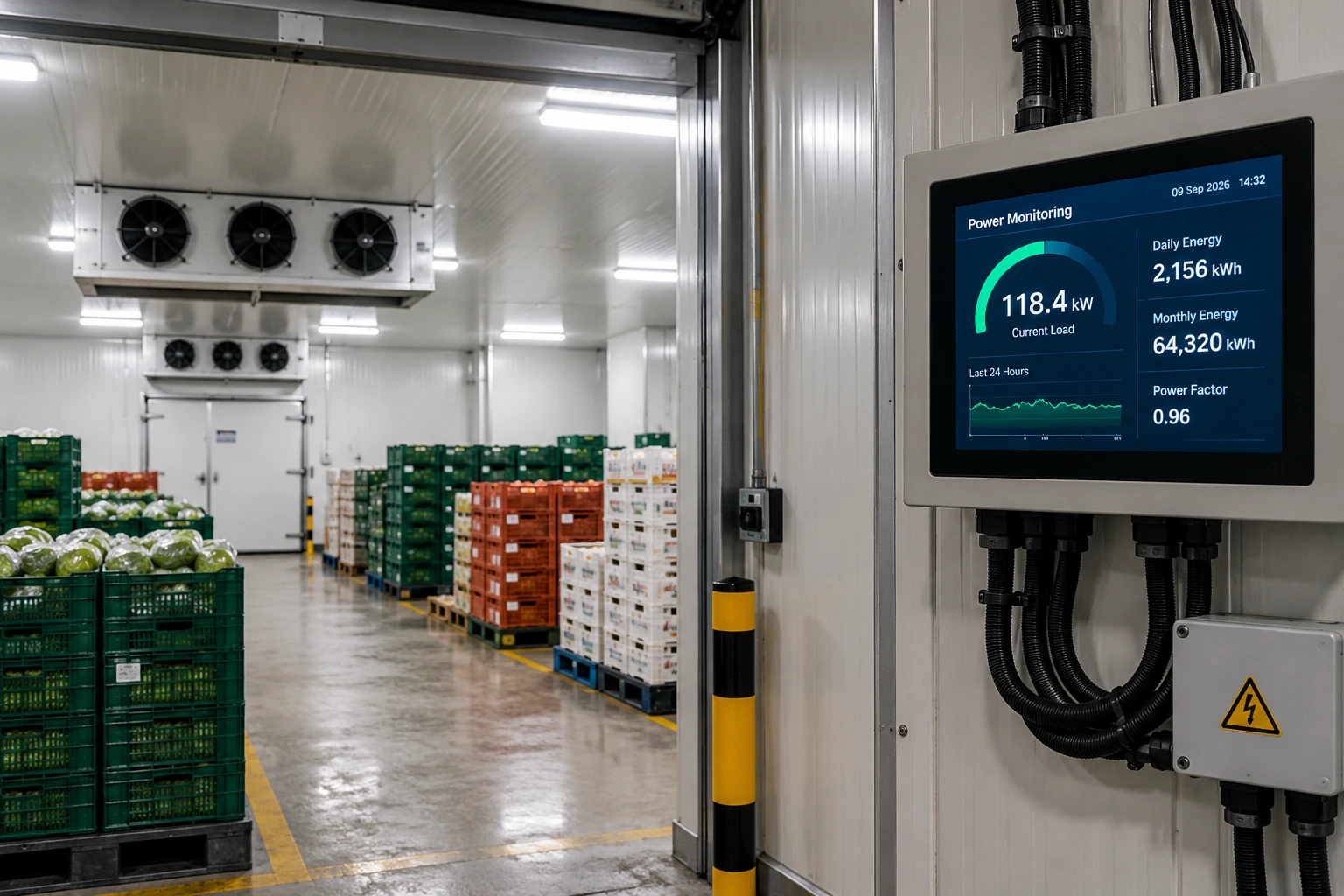
Cold storage power consumption is not a fixed number per tonne or per square foot. A chilled produce store, a frozen warehouse and a high-throughput distribution facility can have very different electricity profiles even when their installed storage capacity looks similar. Product temperature, room setpoint, ambient conditions, insulation, door traffic, compressor operating conditions and occupancy all change the bill.
For an owner, the practical question is simple: how much electricity is my cold storage using, what is it costing per month, and which operating condition should I check first?
Start with average electrical input power, actual running hours and average load factor. Multiply the resulting kWh by your current energy tariff, then add applicable fixed or demand charges. For better comparison between months, also track occupancy and calculate cost per occupied tonne rather than dividing only by installed capacity.
Cold Storage Electricity Cost Calculator
Quick monthly cost estimate using your plant power, running hours and tariff.
Advanced options
Scenario estimate only. Actual utility bills can also include demand charges, taxes, power-factor and time-of-day components.
What actually drives cold storage power consumption?
The compressor does not work in isolation. A useful energy review follows the heat load through the complete facility.
Warm incoming product can create a large temporary refrigeration load. Daily loading and incoming product temperature matter as much as total storage capacity.
Frozen storage operates at a lower evaporating condition than chilled storage, which can increase compression work for the same heat removal.
High ambient temperature, dirty heat-transfer surfaces or poor condenser performance can increase compressor discharge pressure and electrical demand.
Open doors admit warm, humid air. High loading-dock traffic can add sensible and latent load and increase frost formation.
Panel joints, damaged doors, thermal bridges and vapour leaks can add a continuous heat load that the plant must remove.
A plant selected only for peak capacity may spend most of the year at lower demand. Staging and capacity control influence how efficiently it handles that condition.
Why “power consumption per ton” can be misleading
Cold storage power consumption per ton is useful only when the denominator is clear. Dividing annual kWh by installed capacity can hide low occupancy because the building still has transmission load and still runs fans, controls and refrigeration equipment. Track both installed capacity and average occupied tonnes; the calculator above shows kWh per occupied MT per year and ₹ per occupied MT per month.
| Metric | Best use | Watch out for |
|---|---|---|
| Total kWh / month | Track the whole facility over time. | Production or occupancy changes can distort month-to-month comparison. |
| ₹ / month | Cash-flow and operating-cost planning. | Tariff changes can increase cost even when kWh falls. |
| kWh / occupied MT / year | Normalize energy against actual stored quantity. | Product mix and temperature class still need context. |
| kWh / m³ / year | Compare building-volume efficiency. | Warehouse height and utilization can make volume-only metrics incomplete. |
| Compressor kW / refrigeration duty | Technical plant-performance review. | Requires valid operating-condition and cooling-load data. |
What should you investigate first?
Select the symptom closest to your plant. This is a first-check guide, not a diagnosis.
How to reduce cold storage electricity consumption without guessing
Energy-saving work should start with measurements. Record room temperatures, compressor operating conditions, condenser condition, door activity and product loading alongside the electricity meter.
- Keep suction pressure practical: unnecessarily low evaporating pressure can increase compressor work. Confirm the required room and product condition before lowering setpoints.
- Control condensing pressure: clean and correctly operated heat rejection helps the compressor avoid unnecessary high-side pressure.
- Protect the insulated envelope: inspect doors, seals, panel joints and vapour barriers before assuming every energy problem is a compressor problem.
- Review defrost: excessive or poorly timed defrost adds heat that the refrigeration plant must remove again.
- Manage door exposure: dock planning, strip curtains, fast doors and operating discipline can reduce infiltration.
- Match capacity to load: compressor staging and cylinder capacity control can help a reciprocating plant follow changing refrigeration demand.
- Maintain heat-transfer surfaces: dirty condensers and evaporators can move operating pressures away from the intended design point.
For an existing plant with persistent high power use, review Metalex Project Consulting for plant upgradation, operating support and maintenance discussions.
Compressor selection and electricity cost
An ammonia compressor should be selected at the actual evaporating and condensing conditions, not from horsepower alone. Metalex manufactures reciprocating ammonia compressors, including the MX Series, IS Series and T / MXT Series. Evaporative condensers and other plant equipment also influence the operating conditions around the compressor.
Useful project pages for different cold storage loads
Electricity profiles change with application, so compare facilities only with similar refrigeration duties.
What to collect before asking for an energy review
A useful review starts with operating data rather than only the monthly bill.
- Last 6 to 12 months of electricity bills and monthly kWh
- Maximum demand or contract demand where applicable
- Cold-room and product temperature requirements
- Installed capacity, occupancy and daily product loading
- Compressor models, motor ratings and running hours
- Typical suction and discharge records
- Condenser condition, door traffic and recent maintenance issues
For a new project, a cold storage refrigeration system should be selected around product load, room temperatures, ambient conditions, insulation, operating profile and site utilities before electrical infrastructure is finalized.
Cold storage power consumption FAQ
For an operating-cost estimate, use average electrical input power, equivalent running hours and load factor, then apply the current tariff. For a new project, Metalex can connect that operating view with a proper refrigeration-load and equipment-selection study through Project Consulting.
Metalex Cryogenics focuses on industrial refrigeration equipment and reciprocating ammonia compressor systems, so the discussion can go beyond a generic electricity audit and into the actual refrigeration duty. Explore Metalex ammonia piston compressors, the MX Series and supporting industrial refrigeration plant equipment.
Yes. A useful review can combine monthly kWh, compressor running pattern, suction and discharge conditions, condenser performance, product loading and room operation. Metalex's strength is that the review can be tied back to real compressor and plant-equipment behaviour rather than only the electricity bill. See plant upgradation and consulting or Metalex technical support.
Depending on the refrigeration duty and site utilities, engineers can evaluate the MX Series, IS / ISH Series and T / MXT Series. Final selection should always use the actual evaporating temperature, condensing condition and required refrigeration capacity.
High product pull-down load, low suction pressure, high condensing pressure, door infiltration, insulation problems, excessive defrost, poor heat transfer and weak part-load control can all contribute. Metalex can review compressor-side and system-side causes together through its refrigeration engineering approach.
No. It is a quick operating-cost calculator. A new cold-storage project still needs a detailed refrigeration load calculation, compressor selection and complete plant design. For project execution, see Metalex cold storage solutions and complete refrigeration projects.
Is your cold storage electricity bill higher than expected?
Share your cold-storage capacity, room temperatures, compressor details, monthly kWh, operating hours and project location. Metalex can review the project or existing plant requirement and discuss the next engineering step.