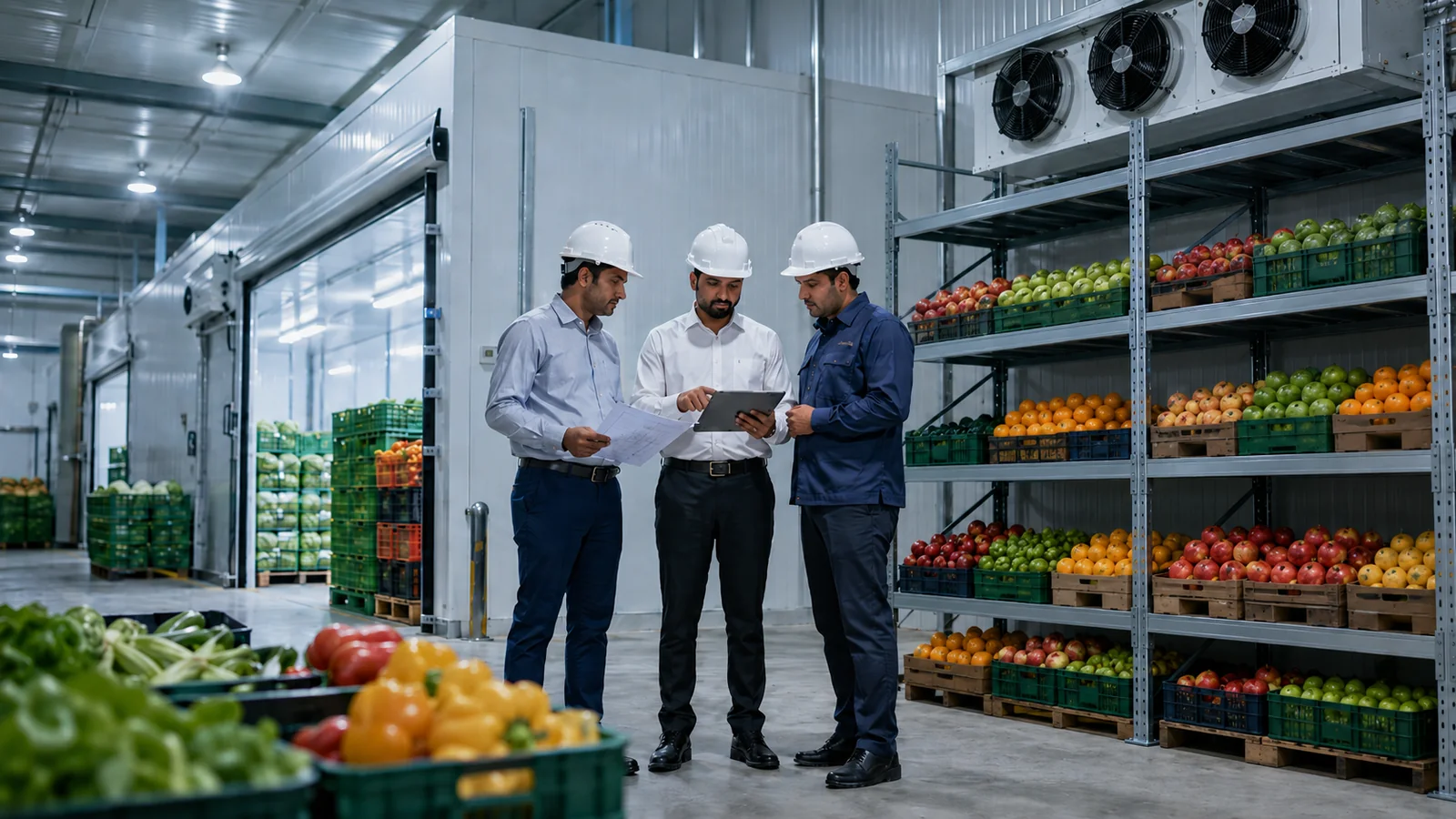
The investment cost of cold storage in India cannot be calculated from capacity alone. A 500 MT potato store, a 500 MT multi-commodity facility and a 500 MT frozen warehouse may have the same nominal capacity but very different civil works, insulation, refrigeration duty, controls and handling systems.
For preliminary planning, use a broad capacity-wise band. For investment approval, obtain a project-specific heat-load calculation, equipment selection, civil and electrical scope, utility plan and commercial quotation.
Indicative cold storage investment ranges in India
The following bands combine current published industry estimates for 2026 and are intended only for early budgeting. They are not Metalex quotations. Land, finance cost, GST, working capital, external infrastructure and special processing equipment may be excluded from published market figures.
| Nominal capacity | Broad planning range | Typical planning context |
|---|---|---|
| 5–20 MT | ₹8 lakh–₹25 lakh | Small modular cold room; scope varies widely by temperature and building readiness. |
| 25–50 MT | ₹25 lakh–₹60 lakh | Small commercial room or multi-room setup with basic utilities. |
| 100–150 MT | ₹70 lakh–₹1.2 crore | Medium commercial facility; civil, panel and refrigeration scope becomes more significant. |
| 400–500 MT | ₹2.5 crore–₹4 crore | Industrial-scale project; published estimates generally assume modern insulated construction. |
| 1,000 MT | ₹4.8 crore–₹7 crore | Modern multi-commodity cold storage market estimate. |
| 5,000 MT | ₹17.5 crore–₹26 crore | Modern industrial multi-commodity project estimate; commodity-specific conventional stores may differ substantially. |
Why are online figures so different? Some estimates cover only refrigeration machinery. Others include the insulated building but exclude land, transformer, generator, racks, handling, pre-cooling or professional fees. A commodity-specific conventional store may also cost far less than a modern multi-temperature warehouse with automation and value-added facilities.
Where the investment actually goes
| Project head | Typical inclusions |
|---|---|
| Land and site development | Land purchase/lease, grading, roads, drainage, boundary, truck movement and external works. |
| Civil and structural works | Foundations, RCC/PEB structure, machine room, loading area, offices, flooring and drainage. |
| Insulated envelope | PUF/PIR panels, vapour barriers, insulated flooring, doors, flashings and sealing details. |
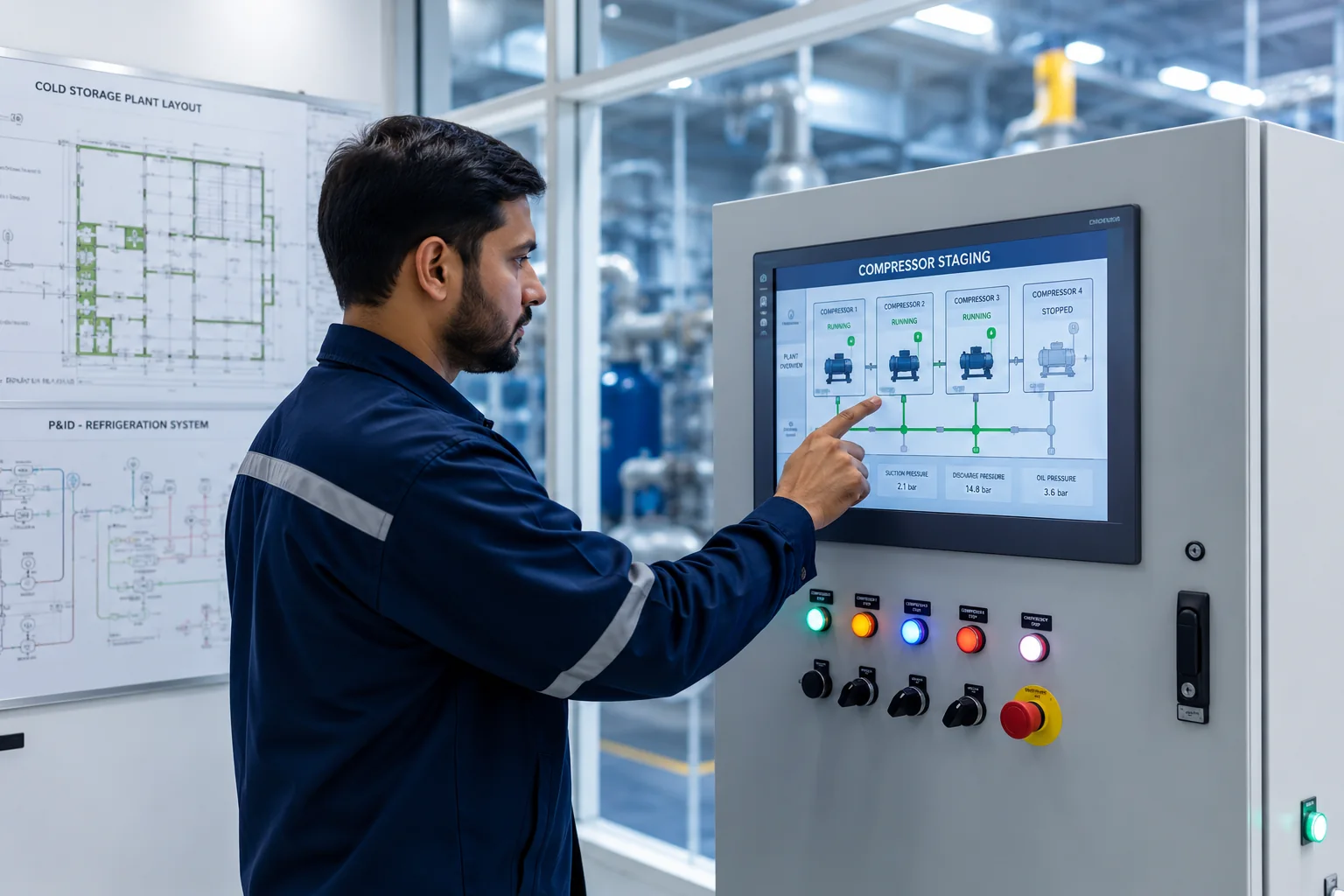
| Refrigeration plant | Compressors, condensers, evaporators, vessels, pumps, valves, piping, insulation and refrigerant controls. |
| Electrical and utilities | Transformer, panels, cabling, DG/backup strategy, water system, lighting and earthing. |
| Material handling | Racks, pallets, crates, forklifts, stackers, conveyors and dock equipment. |
| Controls and monitoring | PLC, sensors, alarms, data logging, energy meters, remote monitoring and access control. |
| Pre-cooling/processing | Pre-coolers, sorting, grading, washing, packing, blast freezer or processing equipment where required. |
| Professional and approval cost | Design, DPR, statutory approvals, consultant fees, testing, commissioning and training. |
| Finance and working capital | Interest during construction, margin money, initial payroll, power deposits and receivables support. |
The design factors that change cost most
- Storage temperature: frozen and low-temperature applications require greater insulation and refrigeration duty than many positive-temperature stores.
- Incoming product temperature: pulling down warm product quickly can dominate compressor and evaporator capacity.
- Commodity and humidity: produce storage may require humidity control, airflow design and product-specific chamber conditions.
- Number of chambers: more zones improve flexibility but add doors, controls, piping and equipment complexity.
- Refrigerant and system architecture: direct expansion, pumped ammonia, secondary systems and packaged systems have different capital and operating profiles.
- Ambient condition and location: summer design temperature, water quality, power reliability, seismic/wind design and logistics affect scope.
- Building type: RCC, PEB, mezzanine floors, high-bay racks and automation change both structural and handling cost.
- Compliance level: food, export, pharma, fire, electrical and refrigerant-safety requirements may require additional systems and documentation.
Costs that are often missed in the first estimate
- Power connection, transformer and demand charges.
- Generator or alternate backup and fuel storage.
- Water treatment and condenser water system.
- Refrigerant charge, oil, commissioning consumables and initial spares.
- Dock, canopy, truck parking and site circulation.
- Fire protection, detection, ventilation and emergency equipment.
- Interest during construction and delayed commercial operation.
- Working capital for seasonal customer credit.
- Insurance, licences, testing and recurring compliance.
- Product crates, pallets, racks, forklifts and IT/stock systems.
The cheapest initial quotation is not necessarily the lowest-cost project. Missing scope returns later as change orders, energy cost, downtime or limited operating flexibility.
Government subsidy and assistance context
Cold-chain projects may qualify for assistance under central or state schemes, subject to eligible entity, component, location, technical standards, application window and approval. Under the Ministry of Food Processing Industries’ revised Integrated Cold Chain guidelines dated 22 May 2025, grants-in-aid are stated at 35% of eligible project cost in general areas and 50% in difficult areas and for specified categories, subject to a maximum of ₹10 crore per project.
NHB also administers capital-investment support for eligible horticulture cold-storage projects under its current scheme framework. Scheme terms and cost norms change, so applicants should verify the latest official guideline and obtain professional financial advice before treating subsidy as confirmed project funding.
Build the project so it remains viable even if approval is delayed or the eligible amount is lower than expected. Expenditure timing can also affect eligibility.
How to prepare a reliable cold storage estimate
Use this sequence before asking vendors for a final quote:
- Define commodity, packaging, monthly quantity and storage duration.
- Confirm incoming temperature, required storage temperature and pull-down time.
- Decide chamber count, usable capacity, stacking method and loading frequency.
- Collect site ambient, power, water and land information.
- Prepare the heat-load calculation and preliminary equipment schedule.
- Freeze inclusions for civil, panel, refrigeration, electrical, handling and controls.
- Obtain comparable quotations against the same technical scope.
- Add contingency, finance cost and working capital.
- Prepare conservative, expected and high-utilization cash-flow scenarios.
Land & site + civil & structure + insulation + refrigeration + electrical & utilities + handling & controls + approvals + finance + working capital + contingencyHow to reduce cost without creating a weak plant
Value engineering should remove unnecessary complexity, not necessary performance. Good opportunities include phasing future chambers, standardising equipment, optimising room dimensions, matching compressor capacity to part-load operation, designing efficient door movement and selecting a system that can be maintained locally.
Do not cut cost by reducing insulation below the required level, undersizing heat rejection, omitting safety systems, eliminating service access or selecting equipment only on lowest purchase price. Those decisions can create a higher lifetime cost.
Frequently asked questions
How much does a cold storage project cost in India?
Published 2026 market estimates range from about ₹8–25 lakh for very small 5–20 MT rooms to ₹4.8–7 crore for a modern 1,000 MT facility and ₹17.5–26 crore for a modern 5,000 MT multi-commodity project. Actual scope can be significantly lower or higher.
Is land included in cold storage cost per tonne?
Often it is not. Always verify whether land, site work, transformer, racks, generator, GST, finance cost and working capital are included.
How much subsidy is available for cold storage?
It depends on the scheme and project. MoFPI’s May 2025 integrated cold-chain guideline states 35% assistance in general areas and 50% in difficult areas/specified categories, capped at ₹10 crore, for eligible project cost and approved projects.
What information is needed for an accurate quotation?
Commodity, capacity, incoming and storage temperature, daily loading, pull-down time, chamber sizes, location, ambient condition, storage system and utility availability.
Cost and scheme references
Indicative market bands reviewed from current industry guides by Phoenixx Smart Build and Priti International. Scheme context checked against the MoFPI revised guidelines dated 22 May 2025, the NHB scheme portal and NCCD.
All figures are broad preliminary ranges, not a quotation or financial recommendation. Verify current prices, taxes, scheme rules and site conditions before investment.